May 7, 2026
Gloire Sebuyange
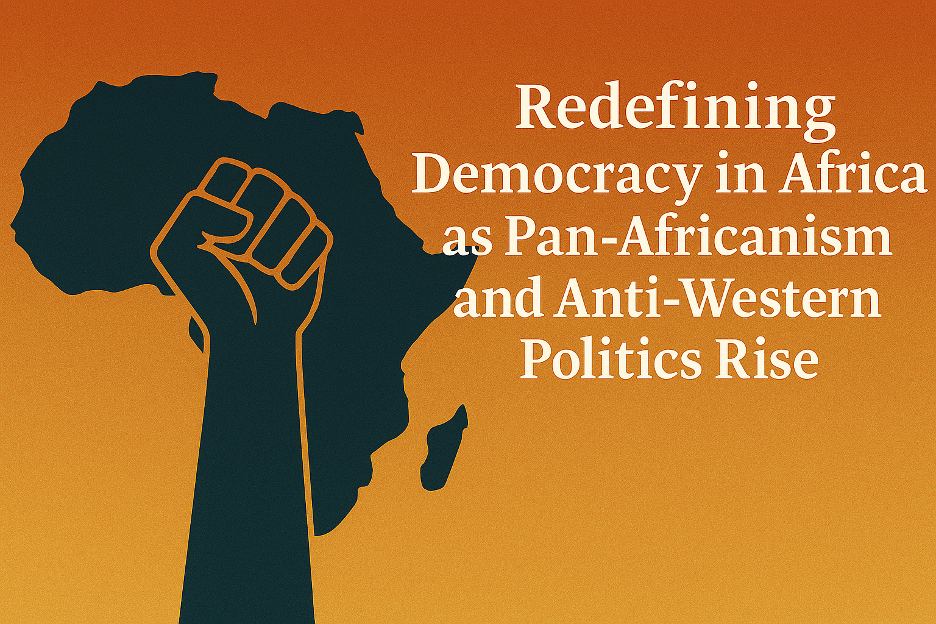
Democracy is currently facing serious implementation challenges across the globe as the international order becomes increasingly authoritarian. In the context of Africa, democracy continues to meet growing resistance, not only from the people but also from leaders who do not necessarily adhere to democratic values and principles. In the central Sahel region for example, democracy continues to face strong resistance. Mali, Burkina Faso, and Niger have recently experienced military coups accompanied by strong anti‑Western rhetoric, particularly against former colonial powers, and France has been obliged to withdraw its troops in these countries. Military juntas receive applause, and the word “sovereignty” rings louder than “democracy.”
People are not just rejecting western democracy in a vacuum, they are strengthening partnerships with countries such as China and Russia, with crowds waving Russian flags while denouncing France. They are not just rejecting democracy, but they are also questioning whose democracy they have been practicing. The 2023 coup in Niger was followed by mass demonstrations condemning French military presence and ECOWAS sanctions. While the West frames such events as “democratic backsliding,” the narrative on the ground sounds different, where leaders argue that democracy has failed to deliver security, dignity, or economic transformation. This raises a poignant question: has democracy really failed because it is inherently ineffective, or because of the lack of political will from leaders who use democratic structures for personal gain? The answer remains debatable and often depends on one’s own context and experience with democratic practices.
Across many African countries, democracy is not resisted, but, rather, distorted. The general understanding of democracy is a governmental system that includes regular multiparty elections, one vote per person, and freedom of speech. Yet not even these three have been effectively explored. In the Democratic Republic of the Congo, for example, the electoral commission has registered 910 political parties as of December 2023. Among many Congolese analysts, this huge number of parties provokes an unending debate whether this is an advantage or a malpractice and misinterpretation of what democracy really is. Does multipartyism mean registering 910 political parties?
In addition, the organization of elections in other countries happens on a regular basis, but are not necessarily free, fair, and transparent. Recent elections have seen incumbents win in highly controversial circumstances. In Tanzania, which had been quietly making democratic progress, President Samia Saluhu won with 97.66 % of votes under controversial Circumstances. In Cameroon Paul Biya, at 92 years old, recently extended his 43-year rule , becoming the world’s oldest president. Have we forgotten Uganda? Of course not, in January 2026, president Yoweri Museveni secured his seventh term with 71.65 % of votes through a process marred by repression. Additionally, President Denis Sassou Nguesso who has ruled the Republic of Congo for 42 years, has just been declared the winner of the recent elections with a massive 94.82% of the vote. These democratic practices in Africa raise debates about electoral organization and multiparty systems, demonstrating that democracy is more than just having a multi-party system and organizing regular elections.
Despite these challenges on the continent, some countries are making democratic progress. For example, Malawi, Senegal, Ghana, South Africa, Botswana, and even Kenya and Nigeria have had peaceful, fair, and democratic transfers of power. In such a context, redefining democracy in Africa requires three steps.
First, democratic legitimacy must extend beyond elections. Citizens evaluate governments based on safety, jobs, and functioning public services. This requires concrete reforms of the security forces, enforcing anti-corruption laws through independent courts and audit institutions, as well as investing in job-creating sectors such as agriculture, manufacturing and renewable energy. Second, it is important to note that true sovereignty is built through capable tax systems, reduced aid dependence, and diversified trade partnerships. It is weakened, not strengthened, when power is centralized without accountability. Third, Pan-Africanism should evolve from rhetoric to regional coordination. If anti-Western sentiment is partly a response to dependency, then regional economic integration under the African Continental Free Trade Area (AfCFTA) offers a constructive path forward. Collective bargaining power in trade, security, and climate negotiations would give substance to calls for autonomy.
Democracy should not just be a concept limited to elections, freedom of speech and multipartyism. Democratic values and principles such as the rule of law, transparency and accountability, civic participation, independent judiciary, as well as ensuring individual liberty among many others must be considered. While democracy has its shortcomings in the West, redefining democracy in Africa amid the rise of Pan‑Africanism and anti‑Western politics still requires values and practices grounded in human rights and cultural principles such as Ubuntu, applied in practice, not just in name.